
How to Plan a Halloween Party Budget Without Overspending
A simple budget planner workflow for food, decor, activities, and the monthly impact of your party.
A simple budget planner workflow for food, decor, activities, and the monthly impact of your party.
Quick answer: Choose the most you can spend before you shop, split that cap into a few party categories, total the plan, and then test the combined cost against your real monthly budget. Keep a small buffer so one forgotten item does not force the whole plan off track.
A useful Halloween party budget is not a list of the cheapest possible ideas. It is a decision tool: it tells you which details matter most, which extras can wait, and whether the total still fits the month. This approach combines a simple event budget planner with a final household-budget check, so the party does not quietly consume money meant for regular bills, savings, or debt payments.
The linked Budget Calculator is a monthly household planner rather than an event-only calculator. Use your notebook or budget tracker to total the party categories first; then place the planned party spending in the closest monthly category, such as Dining & Entertainment, Shopping & Personal, or Miscellaneous, without counting the same cost twice. The calculator can then show how that choice changes your monthly surplus or deficit.
Open The Free Budget Calculator
Set a party cap and divide it into five buckets
Halloween party budget planner with a blank notebook, calculator, receipts, pumpkins, and orange and black decorations.
Start with the spending cap, not the shopping list. Look at the money that is genuinely available after this month’s regular needs, planned savings, and required payments. That available amount is the party cap. If the number feels too small for the first idea, reduce the scope before buying anything: invite fewer people, choose one focal decorating area, simplify the menu, or make the activity the centerpiece instead of trying to upgrade every detail.
Next, write down the guest count and divide the cap into five buckets. A starting split might look like this; adjust it to match the kind of party you actually want:
- Food and drinks - about 40%: snacks, a simple main item, drinks, ice, and serving basics.
- Decor and tableware - about 25%: one strong visual area, lighting, plates, cups, napkins, and reusable pieces.
- Activities or favors - about 15%: games, craft materials, prizes, or small take-home treats.
- Convenience costs - about 10%: delivery fees, last-minute transport, invitations, batteries, or cleanup supplies.
- Buffer - about 10%: money that stays unassigned until a real need appears.
For example, a $250 cap using that starting split becomes $100 for food and drinks, $62.50 for decor and tableware, $37.50 for activities or favors, $25 for convenience costs, and $25 held as a buffer. The percentages are a planning example, not a rule. A potluck may shift more money toward decor; a game night may shift it toward activities. The important part is that every dollar has a job before the cart starts filling up.
Now create the shopping list under those same buckets. Record the estimated cost beside every item and keep a running subtotal. This turns Halloween party planning into a visible tradeoff: adding a photo backdrop may mean using decorations you already own elsewhere, while upgrading the menu may mean skipping favors. The buffer should be used for forgotten needs, not as an invitation to keep adding extras.
Check The Party Plan Against Your Monthly Budget
Test the party plan inside your monthly budget
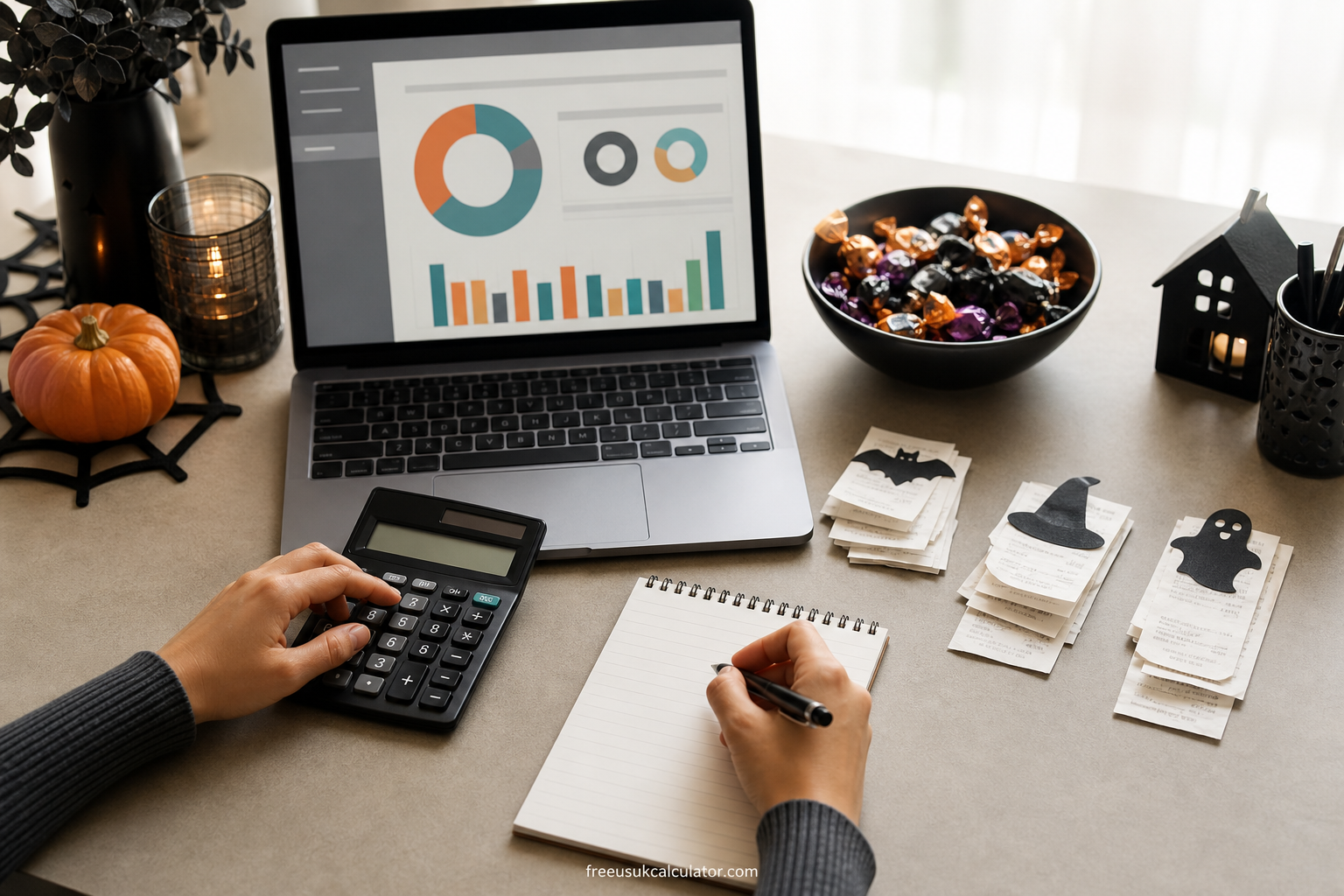
Adult checking a Halloween party spending plan with a calculator, notebook, receipts, and a simple laptop budgeting dashboard.
Once the event tracker has a total, use the Budget Calculator to answer the more important question: does this party still fit the month? The live tool supports United States dollars and United Kingdom pounds, converts pay to a monthly amount, compares income with spending, and shows monthly surplus or deficit. It also includes familiar household categories and a savings goal, which helps keep the party decision in context.
Choose the correct country and currency. Use the United States option for USD or the United Kingdom option for GBP so the monthly figures are easy to review.
Enter real take-home income. Use spendable income after deductions, choose the correct pay frequency, and include only recurring other income you can reasonably expect.
Enter the normal monthly plan first. Fill in housing, utilities, groceries, transportation, debt payments, savings, and the other regular categories before adding the party. That creates an honest baseline.
Add the party cost once. Place the relevant portions in the closest wants categories - for example, party food in Dining & Entertainment and decor or costumes in Shopping & Personal. Use Miscellaneous only for a remainder that does not fit elsewhere, and do not duplicate the same amount.
Review the new surplus or deficit. If the plan creates a deficit or reduces savings below the amount you intended, return to the event tracker and trim lower-priority items. Then rerun the calculator.
Track actual purchases. Replace each estimate in your separate party budget tracker with the real amount paid. If one bucket rises, reduce another bucket or use only part of the buffer.
Keep the calculation honest: Do not reduce rent, minimum debt payments, or other required expenses just to make the party look affordable on screen. The useful adjustment is in the party plan, not in hiding a real monthly obligation.
Recheck the budget once before the main shopping trip and again after the largest purchase. That small habit catches overspending while there are still easy choices to make. A clear plan will not remove every surprise, but it will let you protect the parts of the party that matter most without losing sight of the rest of the month.
Planning note: Results are estimates based on the amounts you enter. Review your actual bills and account balances before making a spending decision.